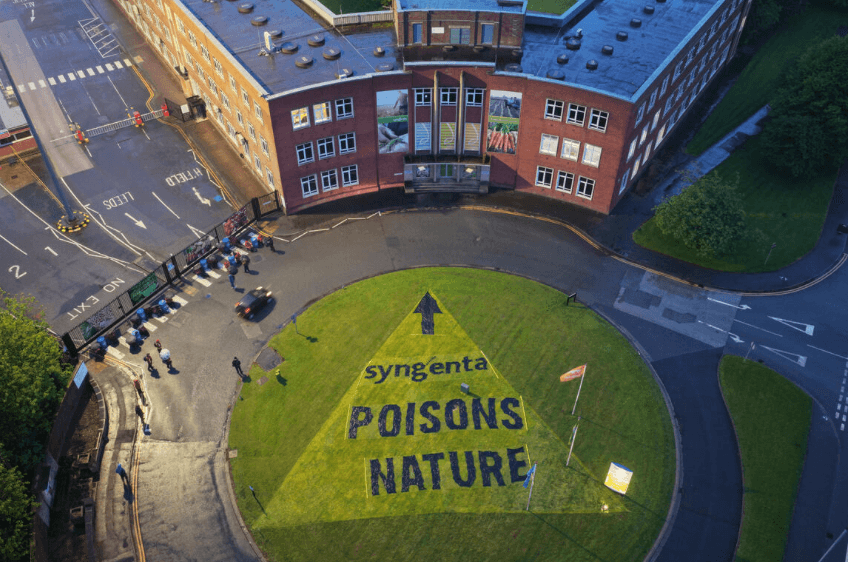
Activists blockade pesticide giant making bee-killing chemical

The Editor
Greenpeace activists have blockaded the UK headquarters of global pesticide company, Syngenta, in Huddersfield, accusing the pesticide giant of driving wildlife decline and threatening our future food security.
Activists have transformed a roundabout outside the front entrance of Syngenta’s HQ into a giant hazard symbol carrying the message “Syngenta poisons nature” with an arrow pointing directly at the building.
Thirty activists are currently locked onto fifteen blue pesticide barrels, blocking all three gates to the site, preventing cars and HGVs from entering or leaving. Eight of the barrels are topped with ultra-realistic sculptures of wildlife threatened by pesticides including a bee, butterfly, bird, fish, frog and hedgehog. The barrels are also painted with Syngenta’s logo, which has been subverted to show the skeleton of a leaf, rather than a healthy green one.
The action comes on World Bee Day and alongside new Greenpeace analysis of official data which reveals just one teaspoon of the Syngenta-made pesticide, Hallmark, whose active ingredient is lambda-cyhalothrin, is enough to kill 13 million bees.
Lambda-cyhalothrin, processed here in Huddersfield by Syngenta, is a powerful insecticide widely used in UK farming. As well as being deadly to bees, it’s classified as a Highly Hazardous Pesticide, very toxic to aquatic life, and a forever chemical (PFAS) which means it is highly persistent in the soil and can accumulate in the food chain. Insecticides like this also starve birds and mammals like hedgehogs by depriving them of their food source.
Greenpeace investigators found that:
Lambda-cyhalothrin is the most-used insecticide on arable land in the UK
6.9 tonnes of lambda-cyhalothrin was applied to over 1 million hectares of British arable crops in 2024 - an area more than 6 times the size of London
Of the 41 products authorised for use in the UK containing lambda-cyhalothrin, 8 are marketed by Syngenta. They are the only one of the 'Big Four' agrochemical companies (Syngenta, Bayer, BASF, Corteva) authorised to sell it in the UK.
The action follows Greenpeace UK’s report Our poisoned land, published last week, which warned that intensive pesticide and fertiliser use is pushing UK wildlife and ecosystems to the brink. The report revealed that commonly eaten British fruit and veg are routinely sprayed with over 100 pesticides before reaching the plate.
Greenpeace analysis found Lambda-cyhalothrin was used during the growing process of common British produce including potatoes, peas, carrots, onions, leeks and strawberries.
Pesticide giants like Syngenta have locked farmers into a reliance on expensive chemical inputs including pesticides and fertilisers. This threatens our food security because as well as damaging soils and poisoning the pollinators that food production depends on, farmers and our food system are more vulnerable to rising costs caused by global instability - as we’ve seen recently with fertiliser price rises.
Nina Schrank, Greenpeace UK campaigner, said: “Our countryside and the wildlife we love is being poisoned by pesticides made and sold by Syngenta. Just one teaspoon of the Syngenta-made pesticide, Hallmark, is enough to kill 13 million bees.
“And pesticide damage doesn’t stop at the edge of a field. These chemicals are wiping out insects, polluting rivers and causing the very foundations of our food system to crumble.
“Meanwhile, Syngenta is making billions while leaving many farmers dependent on their harmful products. That’s why we’re here today: to drag Syngenta out of the shadows and shine a light on the devastation their products are causing to wildlife as well as the threat they pose to our entire food and farming system.
“We need the government to step in, set tighter limits on pesticide use and support farmers to produce healthy food in a nature-friendly way. ”
The UK’s Pesticides National Action Plan aims to reduce pesticide load indicators by 10% from 2018 levels by 2030. This is despite the UK government’s international commitment to halve pesticide risks and excess nutrients by the same date.
Greenpeace is calling for:
- a 50% reduction in pesticide and fertiliser use by 2030
- an 80% reduction by 2040
- funding and support for farmers to reduce reliance on chemical inputs
- tighter restrictions on pesticide use in public spaces and homes