City's tiny Saxon treasure has a big story to tell

The Editor
A beautiful ancient Saxon pendant buried for more than 1,200 years in a Leeds field is giving experts a fascinating glimpse into life in early medieval Yorkshire.
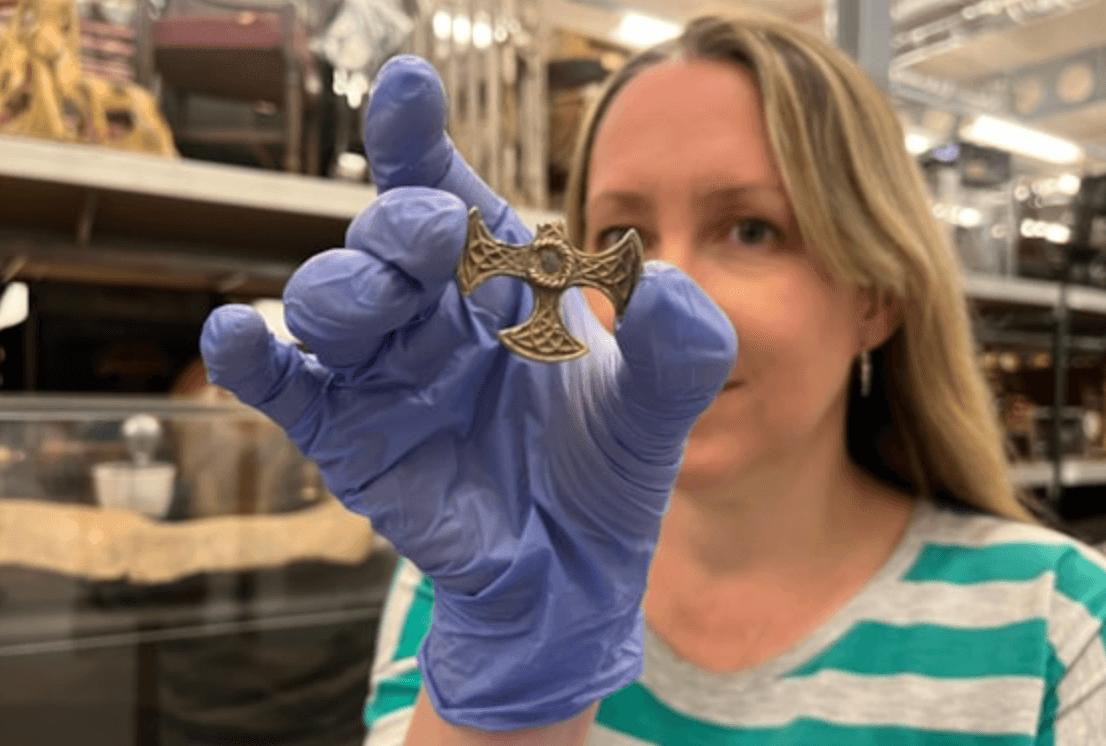
Believed to date from the eighth century, the gilded pectoral cross may have once been a badge of office for an important church leader or official and was unearthed last year by a metal detectorist.
With one arm broken, and the central stone now missing, the cross is nevertheless a stunning example of metalwork, made from solid silver covered with a thin layer of gold leaf.
Decorated with an intricate interlacing Saxon pattern, the remarkable find would have probably been worn around the neck of someone of high status and is the latest in a number of discoveries indicating Leeds and its surrounding area may once have been home to some important and influential figures in the early medieval period.
The small artefact went through the Portable Antiquities Scheme Treasure process, and was secured by Leeds Museums and Galleries thanks to the generous contributions of funders. The cross is now set to go on display at Leeds City Museum later this year.
Kat Baxter, Leeds Museums and Galleries’ curator of archaeology, said: “The cross is beautifully decorated on both sides, which suggests it was designed to hang around the neck with the suspension loop on the missing arm. It would certainly have been worn by someone of high status and is an outward display of religious identity.
“It was made at a time when Leeds was part of the Saxon Kingdom of Northumbria and, along with a number of other discoveries in the area, really helps us build a picture of the types of people who would have lived here during this time”.
The 8th Century saw the earliest known written reference to Leeds, or Loidis, by the historian and monk The Venerable Bede. As well as Northumbia, England’s kingdoms included Mercia, Wessex, and East Anglia.
The cross’s discovery is the latest in a string of significant Saxon and Roman finds made in the Leeds area in recent years.
Just two years ago, a lead coffin buried for more than 1,600 years was discovered in a previously unknown cemetery site near Garforth alongside the remains of more than 60 individuals from late Roman to early Saxon periods.
The coffin contained the remains of a woman aged 25-35, who was buried wearing a bracelet, glass bead necklace and a finger ring or earring.
And in 2012 Leeds Museums and Galleries acquired The West Yorkshire Hoard, a group of seven objects found in the Leeds area by a metal detectorist dating from the seventh to 11th centuries. Five of the objects in the hoard are high quality gold jewellery, which would only have been worn by people of exceptional wealth in Saxon society.
Kat added: “All of these finds are part of a puzzle which together show that Leeds was home to high status, important individuals during the Saxon period, and this beautiful cross is the latest glimpse into the past. Unfortunately, objects representing less wealthy people are less likely to survive.
“There are certainly more objects out there waiting to be discovered, and responsible metal detectorists and The Portable Antiquities Scheme are playing a really important role in increasing our understanding of local history. Without them, this beautiful piece of Saxon metalwork, and many others like it, would never have been found and made available for future generations.”
Funding for the cross came through generous support from the Arts Council England /V&A Purchase Grant Fund, the Leeds Philosophical and Literary Society, and the Friends of Leeds City Museums. It was acquired under The Treasure Act 1996.
Councillor Salma Arif, Leeds City Council’s executive member for adult social care, active lifestyles and culture, said: “This find is a beautiful example of the history all around us and gives a fascinating insight into the story of Leeds.
“It’s always wonderful when we are able to add important objects like this to our collections and we’re very grateful for the continued support of funders and visitors in helping us to preserve our local heritage.”