Jonathan Baldock: Touch Wood

The Editor
The Weston Gallery
23 September 2023 – 14 April 2024
Jonathan Baldock’s new exhibition Touch Wood at The Weston Gallery is a joyous, sensory feast taking inspiration from medieval sculpture, sacred geometry, the seasons and folk motifs.
Jonathan Baldock’s distinctive sculptural installations are immersive environments where colour, texture, scent, sound and humour combine with storytelling and enigmatic characters. Their sensory appeal is underpinned by an unsettling quality, like entering an unknown ritual. Myth, folklore and paganism, with their shapeshifting and fluid creatures, are central to the artist’s work, which offers space to reimagine queer and working people’s histories, explore hidden narratives and create alternative realities.
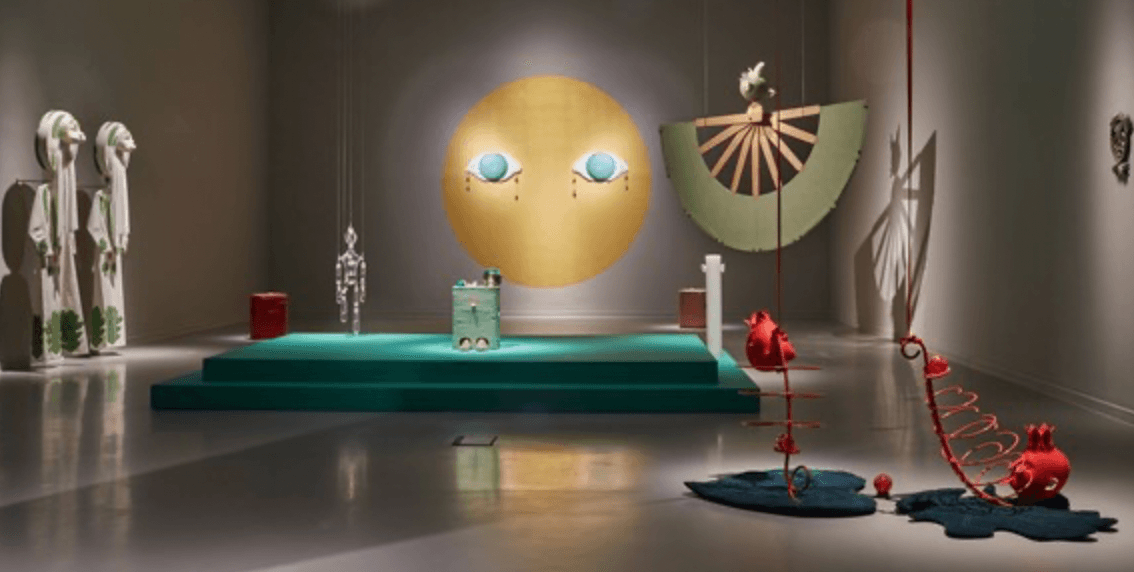
For Touch Wood in YSP’s Weston Gallery, Baldock will create a completely new body of work, embracing textile sculpture and hangings, ceramic sculpture, and an evocative soundscape, created by musician Luke Barton, that unites the show’s themes through song and sampled audio. The artist’s overarching imagery for the exhibition has its origins in the fifteenth-century misericords and carved wooden figures from the quire* of nearby Wakefield Cathedral. Misericords are the protruding, carved shelves concealed underneath folding seats that offered an inconspicuous place to lean and rest while standing to recite prayers of the medieval church. As the misericords were hidden out of sight, the craftspeople who carved them were given secretive freedom in their creation, and their subject matter relates more closely to nature’s bounty or to mythical beasts than it does to overtly religious iconography.
For his exhibition at YSP, Baldock riffs off these characters, with large-scale textile sculptures including a phoenix, a Green Man, and a humorous ‘tumbler’ who bends at the waist to look backwards through his legs whilst exposing his buttocks, embodying the bawdy imagery that was common in medieval times, even within churches. These 500-year-old sculptures inspire Baldock on several levels. As an artist, he enjoys the idea that their makers found pockets of joy in expressing themselves freely outside of the rules. As someone from a working-class background, he connects to the non-authoritarian voice of the craftsperson. As a queer person, he sees the misericords as objects that have survived the repressive ideals of history – they are subversive outsiders hiding in plain sight. Baldock’s own versions will introduce colour, texture, and embellishments through folk motifs. They will invite touch and one can even be sat upon, mirroring the misericords’ function, whilst also transforming them and allowing them to exist on a large scale, bringing them proudly out into the open. The relationship between concealment and visibility is one that resonates with the lives of many LGBTQIA+ people – to pass underneath the heteronormative radar, secrecy can at times equate to safety.
Baldock has a deep-rooted affinity to nature as he hails from generations of hop-gatherers and gardeners who have had a physical, emotional and sustaining relationship with the land. At the centre of the gallery are four textile panels, each representing a different season, and hung in a circle to create a distinct, jewel-like space in the heart of the room. From the paler pastel shades of spring to the rusty tones of autumn, they capture the natural rhythms of a year. Embroidered onto each panel are designs inspired by sacred geometry – the shapes and growth patterns found throughout the natural world that connect all living things. Other textile hangings will form columns in the gallery, suggesting ecclesiastical architecture yet celebrating the earthly seasons.
Casts of the artist’s own face and body parts, as well as those of his mother and partner, feature as flower heads and fragmented appendages attached to, or emerging from, ceramic vessels. Their inclusion binds them together within objects that celebrate the presence of the maker, human relationships, how we hold onto people, and queer love. The ceramics also link to the carvings in Wakefield Cathedral, with one work hinting at a Green Man that has two faces like Janus, the Roman god of beginnings and doorways, who is represented with one face looking backwards and one forwards. Baldock features his own face on one side of a flower and his mother’s on the other, inextricably linking them in one moment in time at the threshold of the past and the future. Filling the gallery is a sound work that draws on and melds together the myriad themes and motifs of the show. It features samples of Gregorian chants, medieval and folk songs, recordings of plants growing and birdsong.
The exhibition’s title, Touch Wood, is many layered and loaded with innuendo. Materially, it refers to the medieval carved figures from which the artist’s ideas grew. Superstition and belief systems also play a part, as the phrase and associated action relate to the desire for future events to go our way and not be jinxed by evil forces. The exact origin of this concept isn’t certain but may derive from an ancient pagan view that spirits reside in trees and that by touching them we invoke their protection. This type of superstitious and shielding gesture is also represented by the symbols Baldock uses across the exhibition that echo the medieval graffiti protection marks found in churches that were thought to ward off the ‘evil eye’.
Baldock’s working techniques draw on past trades and crafts – making skills that have been passed down through generations for practical purposes and which sit at the intersection between art and craft, a place of tension that he playfully inhabits. His materials are of the earth: clay and natural fibres. Avoiding nostalgia, he focuses on “the power of making things, the bringing together of head and hand”, explored through bodily labour, the haptic experience of making by hand, and time-consuming, traditional and self-taught processes.
Sarah Coulson, Senior Curator at YSP, says: “I’m excited to see how Jonathan is so deftly weaving together influences from many different times and spheres, and interpreting them through a contemporary, queer lens. The connection to the carvings in Wakefield Cathedral celebrates the history of sculpture and makers locally, whilst his interest in the natural world and the rhythm of the seasons resonates with the landscape at YSP. Jonathan is a dynamic, thoughtful and playful artist whose installations bring joy as well as challenge.”
- The quire is the area of a church or cathedral that provides seating for the clergy and church choir.